
RSyslog Windows Agent 3.1 Released
Adiscon is proud to announce the 3.1 release of RSyslog Windows Agent.
This is a maintenenance release for RSyslog Windows Agent. It includes some bugfixes as well as a new rule date condition which can be used to process events starting from a certain date. A few new options have been added into the Syslog Service as well.
Detailed information can be found in the version history below.
Build-IDs: Service 3.1.0.134, Client 3.1.0.213
Features |
|
Bugfixes |
|
Version 3.1 is a free download. Customers with existing 2.x keys can contact our Sales department for upgrade prices. If you have a valid Upgrade Insurance ID, you can request a free new key by sending your Upgrade Insurance ID to sales@adiscon.com. Please note that the download enables the free 30-day trial version if used without a key – so you can right now go ahead and evaluate it.
rsyslog 8.10.0 (v8-stable) released
We have released rsyslog 8.10.0.
http://www.rsyslog.com/changelog-for-8-10-0-v8-stable/
Download:
http://www.rsyslog.com/downloads/download-v8-stable/
As always, feedback is appreciated.
Best regards,
Florian Riedl
Changelog for 8.10.0 (v8-stable)
Version 8.10.0 [v8-stable] 2015-05-19
- imfile: add capability to process multi-line messages based on regex input parameter “endmsg.regex” was added for that purpose. The new mode provides much more power in processing different multiline-formats.
- pmrfc3164: add new parameters
- “detect.yearAfterTimestamp”
This supports timestamps as generated e.g. by some Aruba Networks equipment. - “permit.
squareBracesInHostname”
Permits to use “hostnames” in the form of “[127.0.0.1]”; also seen in Aruba Networks equipment, but we strongly assume this can also happen in other cases, especially with IPv6.
- “detect.yearAfterTimestamp”
- supplementary groups are now set when dropping privileges
closes https://github.com/rsyslog/rsyslog/issues/296
Thanks to Zach Lisinski for the patch. - imfile: added brace glob expansion to wildcard
Thanks to Zach Lisinski for the patch. - zmq: add the ability for zeromq input and outputs to advertise their presence on UDP via the zbeacon API.
Thanks to Brian Knox for the contribution. - added omhttpfs: contributed module for writing to HDFS via HTTP
Thanks to sskaje for the contribution. - Configure option “–disable-debug-symbols” added which is disabled per default. If you set the new option, configure won’t set the appropriate compiler flag to generate debug symbols anymore.
- When building from git source we now require rst2man and yacc (or a replacement like bison).
That isn’t any new requirement, we only added missing configure checks. - Configure option “–enable-generate-man-pages” is now disabled for non git source builds per default but enforced when building from git source.
- mmpstrucdata: some code cleanup
removed lots of early development debug outputs - bugfix imuxsock: fix a crash when setting a hostname
Setting a hostname via the legacy directive would lead to a crash during shutdown caused by a double-free.
Thanks to Tomas Heinrich for the patch. - bugfix: memory leak in mmpstrucdata
Thanks to Grégoire Seux for reporting this issue.
closes https://github.com/rsyslog/rsyslog/issues/310 - bugfix (minor): default action name: assigned number was one off
see also https://github.com/rsyslog/rsyslog/pull/340
Thanks to Tomas Heinrich for the patch. - bugfix: memory leak in imfile
A small leak happened each time a new file was monitored based on a wildcard. Depending on the rate of file creation, this could result in a serious memory leak.
Tutorial: Sending impstats Metrics to Elasticsearch Using Rulesets and Queues
Originally posted on the Sematext blog: Monitoring rsyslog’s Performance with impstats and Elasticsearch
If you’re using rsyslog for processing lots of logs (and, as we’ve shown before, rsyslog is good at processing lots of logs), you’re probably interested in monitoring it. To do that, you can use impstats, which comes from input module for process stats. impstats produces information like:
– input stats, like how many events went through each input
– queue stats, like the maximum size of a queue
– action (output or message modification) stats, like how many events were forwarded by each action
– general stats, like CPU time or memory usage
In this post, we’ll show you how to send those stats to Elasticsearch (or Logsene — essentially hosted ELK, our log analytics service, that exposes the Elasticsearch API), where you can explore them with a nice UI, like Kibana. For example get the number of logs going through each input/output per hour:
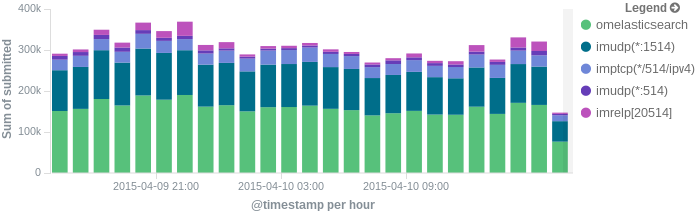
More precisely, we’ll look at:
– useful options around impstats
– how to use those stats and what they’re about
– how to ship stats to Elasticsearch/Logsene by using rsyslog’s Elasticsearch output
– how to do this shipping in a fast and reliable way. This will apply to most rsyslog use-cases, not only impstats
Continue reading “Tutorial: Sending impstats Metrics to Elasticsearch Using Rulesets and Queues”
rsyslog 8.9.0 (v8-stable) released
We have released rsyslog 8.9.0.
http://www.rsyslog.com/changelog-for-8-9-0-v8-stable/
Download:
http://www.rsyslog.com/downloads/download-v8-stable/
As always, feedback is appreciated.
Best regards,
Florian Riedl
Changelog for 8.9.0 (v8-stable)
Version 8.9.0 [v8-stable] 2015-04-07
- omprog: add option “hup.forward” to forwards HUP to external plugins
This was suggested by David Lang so that external plugins (and other
programs) can also do HUP-specific processing. The default is not
to forward HUP, so no change of behavior by default. - imuxsock: added capability to use regular parser chain
Previously, this was a fixed format, that was known to be spoken on
the system log socket. This also adds new parameters:- sysSock.useSpecialParser module parameter
- sysSock.parseHostname module parameter
- useSpecialParser input parameter
- parseHostname input parameter
- 0mq: improvements in input and output modules
See module READMEs, part is to be considered experimental.
Thanks to Brian Knox for the contribution. - imtcp: add support for ip based bind for imtcp -> param “address”
Thanks to github user crackytsi for the patch. - bugfix: MsgDeserialize out of sync with MsgSerialize for StrucData
This lead to failure of disk queue processing when structured data was
present. Thanks to github user adrush for the fix. - bugfix imfile: partial data loss, especially in readMode != 0
closes https://github.com/rsyslog/rsyslog/issues/144 - bugfix: potential large memory consumption with failed actions
see also https://github.com/rsyslog/rsyslog/issues/253 - bugfix: omudpspoof: invalid default send template in RainerScript format
The file format template was used, which obviously does not work for
forwarding. Thanks to Christopher Racky for alerting us.
closes https://github.com/rsyslog/rsyslog/issues/268 - bugfix: size-based legacy config statements did not work properly
on some platforms, they were incorrectly handled, resulting in all
sorts of “interesting” effects (up to segfault on startup) - build system: added option –without-valgrind-testbench
… which provides the capability to either enforce or turn off
valgrind use inside the testbench. Thanks to whissi for the patch. - rsyslogd: fix misleading typos in error messages
Thanks to Ansgar Püster for the fixes.
Using rsyslog and Elasticsearch to Handle Different Types of JSON Logs
Originally posted on the Sematext blog: Using Elasticsearch Mapping Types to Handle Different JSON Logs
By default, Elasticsearch does a good job of figuring the type of data in each field of your logs. But if you like your logs structured like we do, you probably want more control over how they’re indexed: is time_elapsed an integer or a float? Do you want your tags analyzed so you can search for big in big data? Or do you need it not_analyzed, so you can show top tags via the terms aggregation? Or maybe both?
In this post, we’ll look at how to use index templates to manage multiple types of logs across multiple indices. Also, we’ll explain how to use rsyslog to handle JSON logging and specify types.
Elasticsearch Mapping and Logs
To control settings for how a field is analyzed in Elasticsearch, you’ll need to define a mapping. This works similarly in Logsene, our log analytics SaaS, because it uses Elasticsearch and exposes its API.
With logs you’ll probably use time-based indices, because they scale better (in Logsene, for instance, you get daily indices). To make sure the mapping you define today applies to the index you create tomorrow, you need to define it in an index template.
Managing Multiple Types
Mappings provide a nice abstraction when you have to deal with multiple types of structured data. Let’s say you have two apps generating logs of different structures: both have a timestamp field, but one recording logins has a user field, and another one recording purchases has an amount field.
To deal with this, you can define the timestamp field in the _default_ mapping which applies to all types. Then, in each type’s own mapping we’ll define fields unique to that mapping. The following snippet is an example that works with Logsene, provided that aaaaaaaa-bbbb-cccc-dddd-eeeeeeeeeeee is your Logsene app token. If you roll your own Elasticsearch, you can use whichever name you want, and make sure the template name applies to matches index pattern (for example, logs-* will work if your indices are in the logs-YYYY-MM-dd format).
curl -XPUT 'logsene-receiver.sematext.com/_template/aaaaaaaa-bbbb-cccc-dddd-eeeeeeeeeeee_MyTemplate' -d '{
 "template" : "aaaaaaaa-bbbb-cccc-dddd-eeeeeeeeeeee*",
 "order" : 21,
 "mappings" : {
  "_default_" : {
   "properties" : {
    "timestamp" : { "type" : "date" }
   }
  },
  "firstapp" : {
   "properties" : {
    "user" : { "type" : "string" }
   }
  },
  "secondapp" : {
   "properties" : {
    "amount" : { "type" : "long" }
   }
  }
 }
}'
Sending JSON Logs to Specific Types
When you send a document to Elasticsearch by using the API, you have to provide an index and a type. You can use an Elasticsearch client for your preferred language to log directly to Elasticsearch or Logsene this way. But I wouldn’t recommend this, because then you’d have to manage things like buffering if the destination is unreachable.
Instead, I’d keep my logging simple and use a specialized logging tool, such as rsyslog, to do the hard work for me. Logging to a file is usually the easiest option. It’s local, and you can have your logging tool tail the file and send contents over the network. I usually prefer sockets (like syslog) because they let me configure rsyslog to:
– write events in a human format to a local file I can tail if I need to (usually in development)
– forward logs without hitting disk if I need to (usually in production)
Whatever you prefer, I think writing to local files or sockets is better than sending logs over the network from your application. Unless you’re willing to do a reliability trade-off and use UDP, which gets rid of most complexities.
Opinions aside, if you want to send JSON over syslog, there’s the JSON-over-syslog (CEE) format that we detailed in a previous post. You can use rsyslog’s JSON parser module to take your structured logs and forward them to Logsene:
module(load="imuxsock")        # can listen to local syslog socket
module(load="omelasticsearch") # can forward to Elasticsearch
module(load="mmjsonparse")     # can parse JSON

action(type="mmjsonparse")  # parse CEE-formatted messages

template(name="syslog-cee" type="list") {  # Elasticsearch documents will contain
  property(name="$!all-json")              # all JSON fields that were parsed
}

action(
  type="omelasticsearch"
  template="syslog-cee"                     # use the template defined earlier
  server="logsene-receiver.sematext.com"
  serverport="80"
  searchType="syslogapp"
  searchIndex="LOGSENE-APP-TOKEN-GOES-HERE"
  bulkmode="on"                                # send logs in batches
  queue.dequeuebatchsize="1000"                # of up to 1000
  action.resumeretrycount="-1"    # retry indefinitely (buffer) if destination is unreachable
)
To send a CEE-formatted syslog, you can run logger ‘@cee: {“amount”: 50}’ for example. Rsyslog would forward this JSON to Elasticsearch or Logsene via HTTP. Note that Logsene also supports CEE-formatted JSON over syslog out of the box if you want to use a syslog protocol instead of the Elasticsearch API.
Filtering by Type
Once your logs are in, you can filter them by type (via the _type field) in Kibana:

However, if you want more refined filtering by source, we suggest using a separate field for storing the application name. This can be useful when you have different applications using the same logging format. For example, both crond and postfix use plain syslog.
rsyslog 8.8.0 (v8-stable) released
We have released rsyslog 8.8.0.
http://www.rsyslog.com/changelog-for-8-8-0-v8-stable/
Download:
http://www.rsyslog.com/downloads/download-v8-stable/
As always, feedback is appreciated.
Best regards,
Tim Eifler
Changelog for 8.8.0 (v8-stable)
Version 8.8.0 [v8-stable] 2015-02-24
- omkafka: add support for dynamic topics and auto partitioning
Thanks to Tait Clarridge for the patches. - imtcp/imptcp: support for broken Cisco ASA TCP syslog framing
- omfwd: more detailled error messages in case of UDP send error
- TLS syslog: enable capability to turn on GnuTLS debug logging
This provides better diagnostics in hard-to-diagnose cases,
especially when GnuTLS is extra-picky about certificates. - bugfix: $AbortOnUncleanConfig did not work
- improve rsyslogd -v output and error message with meta information
version number is now contained in error message and build platform in
version output. This helps to gets rid of the usual “which version”
question on mailing list, support forums, etc… - bugfix imtcp: octet-counted framing cannot be turned off
- bugfix: build problems on Illuminos
Thanks to Andrew Stormont for the patch - bugfix: invalid data size for iMaxLine global property
It was defined as int, but inside the config system it was declared as
size type, which uses int64_t. With legacy config statements, this could
lead to misadressing, which usually meant the another config variable was
overwritten (depending on memory layout).
closes https://github.com/rsyslog/rsyslog/issues/205 - bugfix: negative values for maxMessageSize global parameter were permitted
RSyslog Windows Agent 3.0 Released
Adiscon is proud to announce the 3.0 release of RSyslog Windows Agent.
This new major release adds full support for Windows 2012 R2 and also has been verified to work on Windows 10 preview versions.
The new major version is a milestone in many ways. Most important the performance of the core engine has been considerably increased. All existing configurations will benefit from this. Also a new Configuration Client has been added which has been rewritten using the .Net Framework (Like the InterActive Syslog Viewer). With the new Configuration Client, we also introduce support for a new file based configuration format (as an alternative to the registry-based method). RSyslog Windows Agent can now run from a configuration file and save it state values
into files.
We also extended the classic EventLog Monitor to support multiple dynamic *.evt files for NetApp customers.
Detailed information can be found in the version history below.
Build-IDs: Service 3.0.130, Client 3.0.201
Features |
|
Bugfixes |
|
Version 3.0 is a free download. Customers with existing 2.x keys can contact our Sales department for upgrade prices. If you have a valid Upgrade Insurance ID, you can request a free new key by sending your Upgrade Insurance ID to sales@adiscon.com. Please note that the download enables the free 30-day trial version if used without a key – so you can right now go ahead and evaluate it.