
What rsyslog is today: a high-performance log ingestion and ETL engine
The site title and GitHub project tagline now describe rsyslog as a high-performance log ingestion and ETL engine.
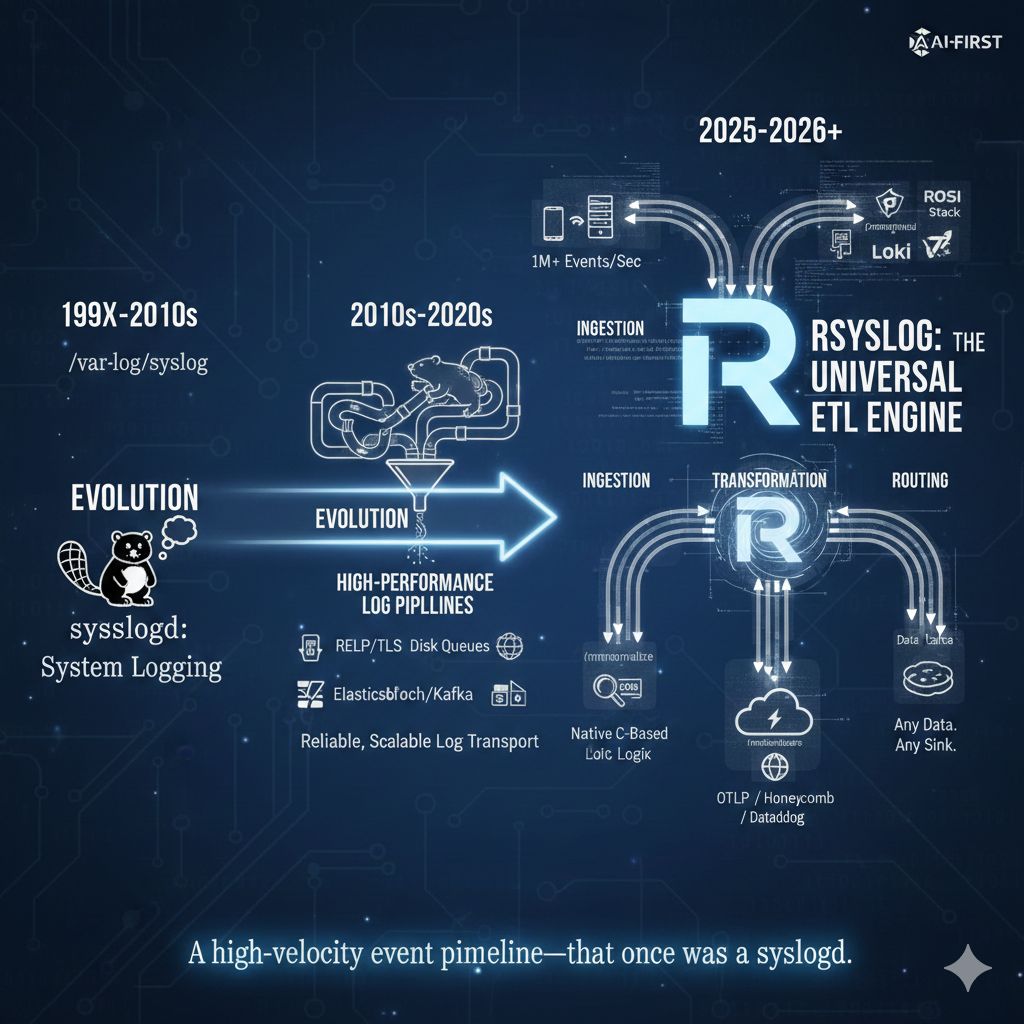
This is a small but visible change. It reflects how rsyslog is actually used today in modern infrastructures, and it aligns the project’s public description with long-standing technical reality. It is not a rebranding exercise, and it does not change what rsyslog is compatible with or where it comes from.
If you have followed the project for a long time, the wording may stand out. That is intentional. It acknowledges an evolution that has been underway for years and that many users already rely on in production.
Why the site title changed
Rsyslog is still often perceived primarily as a classic syslog daemon. Given the project name and its history, that perception is understandable. At the same time, it is increasingly incomplete.
In real deployments, rsyslog frequently acts as the first stage of log and event pipelines. It efficiently ingests data, transforms it, and routes it reliably to downstream systems. The updated site title and GitHub tagline make that role explicit at first glance.
This builds directly on an earlier article that addressed the same misconception in more detail: Myth-Buster: rsyslog is not just a legacy syslogd. What is new now is that this understanding is reflected directly in the project’s most visible descriptors.
What rsyslog does in practice
Modern rsyslog installations typically perform tasks that closely match ETL patterns for log and event data:
- ingesting data from local systems, network protocols, files, and applications
- parsing and normalizing unstructured and structured logs
- enriching events with metadata and context
- filtering and routing messages based on content
- delivering data reliably to multiple destinations in parallel
These pipelines are designed for high throughput and predictable behavior under load. Disk-assisted queues, backpressure control, transactional transports, and multi-threaded processing are core design elements. They are the reason rsyslog is often placed in front of observability, analytics, and security backends.
Why “ETL” fits
Using the term ETL does not imply batch analytics or data warehousing. It describes the function rsyslog fulfills in log pipelines: extracting events from diverse sources, transforming them into a usable and consistent form, and loading them into one or more sinks.
Seen this way, rsyslog has effectively acted as a log-focused ETL engine for a long time. The updated wording simply names that role more clearly.
What did not change
rsyslog remains fully compatible with traditional syslog workflows. It can still be used as a straightforward system logger writing to local files. Existing configurations continue to work, and compatibility remains a deliberate design goal.
The name also stays. rsyslog carries a long operational history and a high level of trust in production environments. Over time, it has become a proper noun rather than a literal description of scope.
A broader context
The updated site title also fits into a wider effort around modern log and observability architectures. Work such as the Rsyslog Operations Stack Initiative (ROSI) explores how efficient ingestion, transformation, and routing can be combined with downstream observability components in a coherent and cost-aware way.
In that context, rsyslog’s role as a high-performance ingestion and ETL layer is not theoretical. It is a practical foundation for building scalable observability stacks.
Bottom line
Changing a site title or a GitHub tagline is a small step. On its own, it would mean little. In this case, it serves as a visible signal of how rsyslog is already designed and used today.
Rsyslog did not stop being compatible with syslog. It stopped being only a syslog daemon long ago. Describing it as a high-performance log ingestion and ETL engine is simply the most accurate summary of what it is today.